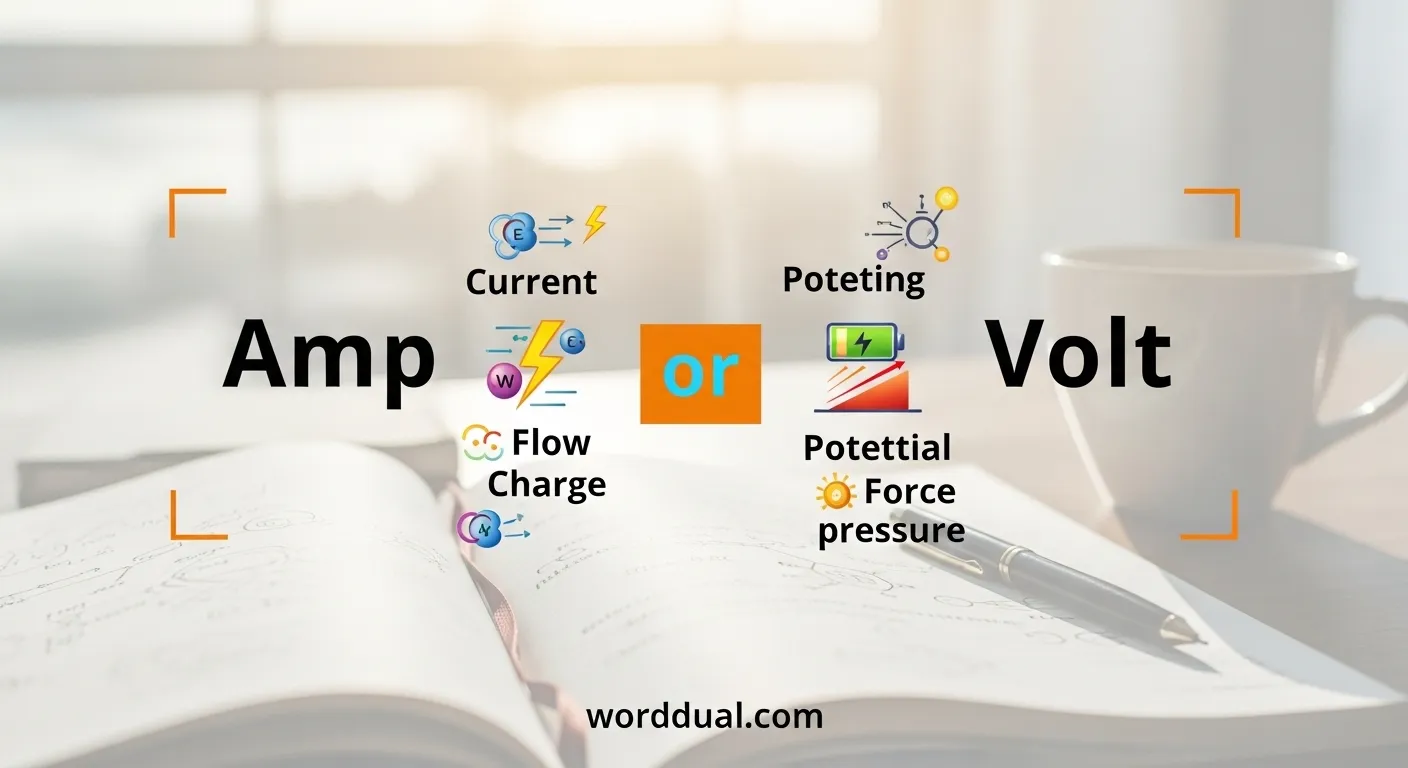
Electricity powers our world, yet many of us confuse its fundamental units amp and volt.
Last year, my cousin tried installing solar panels at home.
When he asked the technician whether he should focus on amps or volts, the explanation seemed complicated. He wondered: aren’t they the same?
This real-life scenario highlights why understanding the difference between amp and volt is crucial.
Both units measure electrical phenomena but in entirely different ways. Amps indicate the flow of electric current, while volts represent the pressure pushing the current.
Knowing the difference helps electricians, engineers, and even everyday users make informed decisions safely.
In this blog, we’ll explore their meaning, usage, behavior, and why this distinction matters in society.
By the end, you’ll be able to confidently explain the difference between amp and volt in any context.
Pronunciation:
- Amp – US /æmp/, UK /æmp/
- Volt – US /voʊlt/, UK /vəʊlt/
Before diving deep, let’s hook into the main part: understanding amps and volts is like understanding water in a pipe: one measures the flow, the other the pressure.
Let’s explore the difference between amp and volt in detail.
Difference Between Amp and Volt
Here are 10 key differences, each with examples for clarity:
- Definition
- Amp: Measures the flow of electric current.
- Volt: Measures electric potential or pressure.
Example 1: A 2-amp phone charger delivers 2 units of current to your phone.
Example 2: A 5-volt USB port ensures the right pressure to charge devices safely.
- Unit Symbol
- Amp → A
- Volt → V
Example 1: Light bulbs are rated at 0.5 A.
Example 2: Household sockets are 120 V in the US.
- Physical Meaning
- Amp: Flow of electrons.
- Volt: Force pushing electrons.
Example 1: A river carrying water represents amps.
Example 2: A water pump creating pressure represents volts.
- Measurement Instrument
- Amp: Measured with an ammeter.
- Volt: Measured with a voltmeter.
Example 1: Electricians check amps to avoid overloads.
Example 2: Voltmeters measure battery health by voltage.
- Energy Transfer
- Amp: Indicates how much charge passes a point per second.
- Volt: Determines energy per unit charge.
Example 1: A 3 A current can power a fan efficiently.
Example 2: 12 V batteries provide enough potential energy for small devices.
- Relation to Resistance
- Amp: Decreases when resistance increases (Ohm’s law).
- Volt: Depends on both current and resistance.
Example 1: High-resistance wires reduce current flow.
Example 2: A 9 V battery may produce low current if a resistor is added.
- Applications
- Amp: Charging devices, running motors, and circuits.
- Volt: Lighting, household appliances, and battery ratings.
Example 1: Electric cars need high amps for fast charging.
Example 2: Homes require standard voltage for appliances to function safely.
- Symbolic Use
- Amp: Represents strength or intensity.
- Volt: Represents potential or energy.
Example 1: Amp up your performance means increase intensity.
Example 2: High-voltage moment represents tension or excitement.
- Nature and Behavior
- Amp: Always involves movement (current).
- Volt: Can exist without current (static potential).
Example 1: Current flows in a circuit with amps.
Example 2: Static electricity shows voltage without amps.
- Safety Considerations
- Amp: Higher amps can be dangerous and cause overheating.
- Volt: High voltage can cause electric shocks.
Example 1: Electricians check amp ratings before repairs.
Example 2: Warning signs for 220 V lines protect people from shocks.
Nature and Behavior of Amp and Volt
- Amp: Dynamic and visible through current flow. Increasing amps means more electrons move through a conductor.
- Volt: Potential energy is invisible until a path is provided. Voltage exists even when current is zero.
Why People Are Confused
Many confuse amps with volts because both are fundamental to electricity. They are interdependent volts push, amps flow yet each measures a different aspect. Misunderstanding can lead to using wrong appliances, poor energy efficiency, or safety risks.
Amp vs Volt Table: Differences and Similarities
| Feature | Amp (A) | Volt (V) | Similarity |
| Measures | Current flow | Electric potential | Both are electrical units |
| Symbol | A | V | Standard SI units |
| Instrument | Ammeter | Voltmeter | Both used by electricians |
| Effect | Determines power delivery | Determines energy pressure | Affect electrical circuits |
| Presence | Requires a complete circuit | Exists even without flow | Fundamental to electricity |
| Safety | High amps = overheating | High volts = shock hazard | Both need caution |
| Common Use | Motors, chargers | Batteries, homes | Essential in everyday electronics |
| Analogy | Water flow | Water pressure | Helps understand electric behavior |
| Dynamic/Static | Dynamic | Static possible | Conceptual in physics |
| Positive/Negative Impact | Overheating if uncontrolled | Shock if too high | Both influence electrical safety |
Which is Better in What Situation?
- Amps: Better when focusing on energy delivery. For instance, electric vehicles and high-power tools need higher amps to function efficiently. Low-voltage devices may require fewer amps to avoid damage.
- Volts: Better when the concern is energy potential or safety. Household appliances rely on stable voltage to prevent malfunction. Batteries are rated in volts to maintain compatibility across devices.
Use in Metaphors and Similes
- Amp: His enthusiasm amped the room like a surge of electricity.
- Volt: Her energy was like 220 volts intense and unstoppable.
Connotation:
- Amp: Positive (strength, intensity) – e.g., amplified success
- Volt: Neutral/Positive (potential energy, excitement) – e.g., high-voltage performance
Idioms/Proverbs:
- Amp up – increase energy or intensity → We need to amp up our efforts.
- High voltage – very exciting or dangerous → The debate was high voltage.
Works in Literature
- Amped Up (Fiction, Jane Doe, 2018) – explores energy in futuristic cities.
- Voltage (Science, John Smith, 2020) – detailed exploration of electrical principles.
Movies on Keywords
- Amped (2011, US) – Drama about young inventors using electricity.
- High Voltage (2012, Australia) – Action thriller involving power sabotage.
FAQs
- Can volts exist without amps?
Yes, voltage can exist without current, like in a charged battery. - Are amps and volts interchangeable?
No, amps measure flow, volts measure pressure; they are related but not the same. - Which is safer to touch?
Low amps or low volts are generally safer; high volts or high amps can be dangerous. - Does increasing volts increase amps?
It depends on resistance (Ohm’s law: I = V/R). - Can one device require both high amps and high volts?
Yes, heavy machinery often requires both for proper functioning.
How Both Are Useful for Surroundings
- Amps: Control energy consumption in homes, industries, and devices.
- Volts: Ensure correct energy distribution, prevent short circuits, and maintain appliance safety.
Final Words
Understanding the difference between amp and volt is essential for students, engineers, and everyday users. These units might seem abstract, but their proper application ensures safety, efficiency, and innovation in society.
Conclusion
In conclusion, amps and volts are like the heartbeat and blood pressure of electrical systems.
Amps measure the flow of electrons, while volts indicate the potential pushing them.
Their distinct roles make them indispensable in daily life, from charging phones to powering industries.
By learning their differences, pronunciation, and behavior, users can ensure proper usage, prevent hazards, and optimize electricity efficiently.
From metaphors to literature, the influence of amps and volts extends beyond physics into culture, art, and everyday language.
Understanding these units enriches knowledge and empowers safe and intelligent use of electricity in our modern world.

I’m Noah Penfield, a content strategist who writes high-ranking comparison articles about confusing English words. I combine SEO research with language clarity to create guides that answer real user questions. My mission is to help writers improve vocabulary, avoid mistakes, and communicate more effectively.