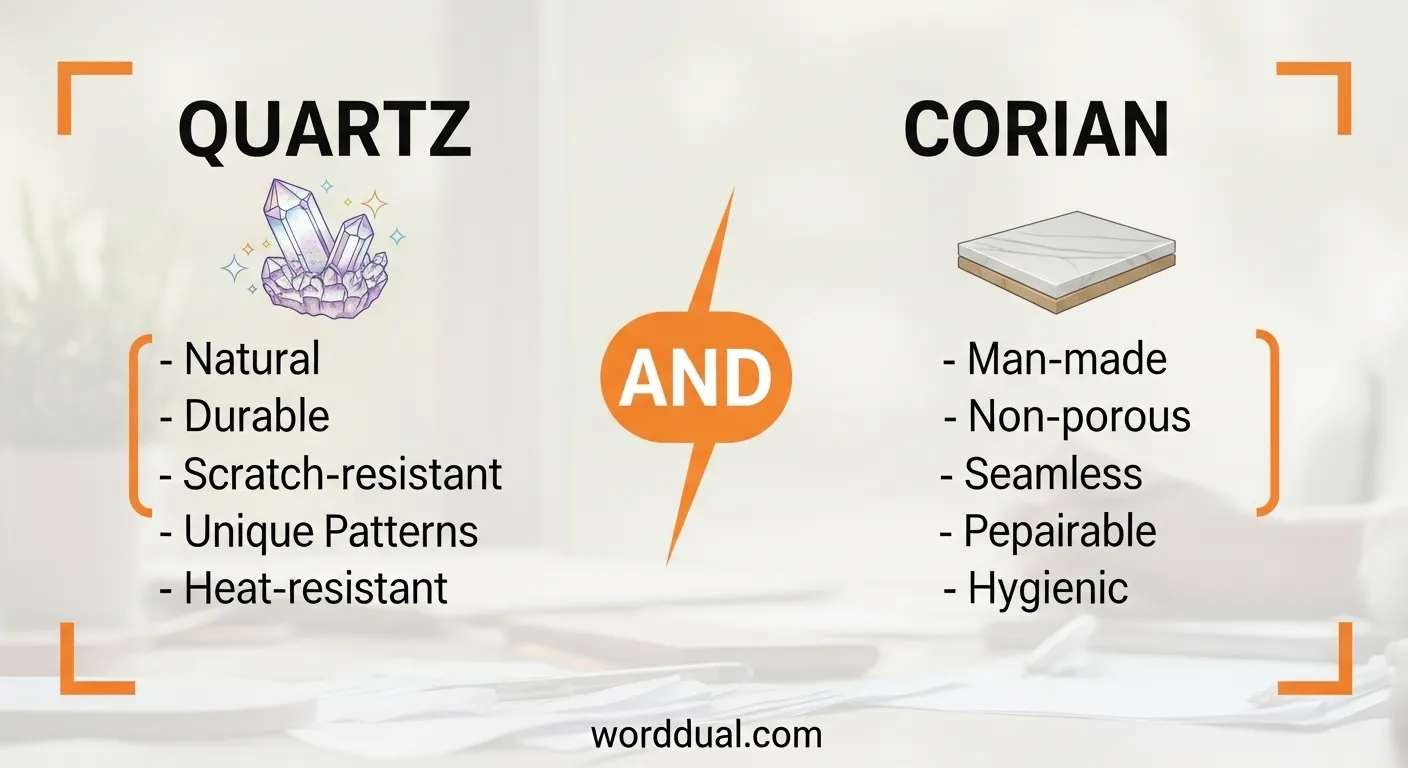
Last month, a friend was renovating his kitchen.
At the showroom, one designer suggested quartz countertops, while another recommended Corian.
Confused, he asked, What is the real difference between quartz and Corian?
That simple question started a discussion about durability, appearance, cost, and maintenance.
Many homeowners face the same confusion. Both materials look modern and durable, but the difference between quartz and Corian lies in their composition and performance.
Understanding the difference between quartz and Corian helps homeowners and designers choose the right countertop.
Before exploring the difference between quartz and Corian, let’s first look at how these words are pronounced.
Pronunciation of Quartz and Corian
Quartz
- US: /kwɔːrts/
- UK: /kwɔːts/
Corian
- US: /ˈkɔːriən/
- UK: /ˈkɔːriən/
Both words sound simple, but their materials and properties are quite different.
Now that we know the basics, let’s explore the detailed difference between quartz and Corian and understand how each material performs in real-life situations.
Difference Between Quartz and Corian
Below are ten clear points that explain the difference between quartz and Corian.
1. Material Composition
Quartz countertops are engineered stone made from natural quartz crystals mixed with resin and pigments.
Corian is a solid surface material made from acrylic polymer and natural minerals.
Examples
Quartz examples
- A kitchen island made from quartz resists scratches and stains.
- Luxury homes often install quartz countertops for durability.
Corian examples
- Bathroom vanities often use Corian for seamless sinks.
- Modern offices sometimes install Corian desks.
2. Appearance
Quartz usually looks like natural stone and often resembles marble or granite.
Corian has a smoother and more uniform appearance.
Examples
Quartz
- A marble-style quartz countertop in a modern kitchen.
- A white quartz island with gray veins.
Corian
- A solid white Corian countertop in a minimalist kitchen.
- A seamless Corian sink attached to the countertop.
3. Durability
Quartz is extremely hard and scratch-resistant.
Corian is softer and can scratch more easily.
Examples
Quartz
- Cutting vegetables directly on quartz rarely damages it.
- Heavy pots usually do not scratch quartz surfaces.
Corian
- Knife marks may appear on Corian countertops.
- Scratches on Corian can be sanded and repaired.
4. Heat Resistance
Quartz handles heat fairly well but can still be damaged by extreme heat.
Corian is less heat resistant and can burn or warp.
Examples
Quartz
- Placing a warm pan briefly on quartz usually causes no damage.
- Baking trays should still use trivets.
Corian
- A hot pot may leave marks on Corian.
- Heat pads are necessary on Corian countertops.
5. Maintenance
Quartz is low maintenance and does not require sealing.
Corian requires more care but is easier to repair.
Examples
Quartz
- Cleaning with soap and water is enough.
- Quartz rarely stains.
Corian
- Small scratches can be polished out.
- Corian surfaces may need periodic refinishing.
6. Seam Visibility
Quartz slabs often show visible seams where pieces meet.
Corian can be joined with almost invisible seams.
Examples
Quartz
- Large kitchen counters show joints between slabs.
- Long islands may have visible seams.
Corian
- Seamless countertops in hospitals.
- Integrated sinks without visible joints.
7. Design Flexibility
Quartz is strong but less flexible in shaping.
Corian can be thermoformed, meaning it can be molded into curves.
Examples
Quartz
- Straight countertop edges.
- Square kitchen islands.
Corian
- Curved reception desks.
- Custom shaped bathroom counters.
8. Cost
Quartz is usually more expensive than Corian.
Corian is often a budget-friendly alternative.
Examples
Quartz
- High-end kitchen renovations use quartz.
- Luxury apartments install quartz countertops.
Corian
- Affordable kitchen remodels use Corian.
- Rental homes often install Corian surfaces.
9. Weight
Quartz is heavier because it contains natural stone.
Corian is lighter due to acrylic materials.
Examples
Quartz
- Requires strong cabinets for support.
- Professional installation is necessary.
Corian
- Easier to transport and install.
- Suitable for wall surfaces.
10. Environmental Impact
Quartz uses natural stone resources but lasts a long time.
Corian is synthetic but can be repaired and reused.
Examples
Quartz
- Long lifespan reduces replacement waste.
- Durable surfaces last decades.
Corian
- Scratches can be repaired instead of replacing.
- Some Corian materials are recyclable.
Nature and Behavior of Both Materials
Quartz
Quartz is rigid, dense, and highly durable.
It behaves like natural stone and resists scratches, stains, and bacteria.
Corian
Corian is soft, flexible, and repairable.
It is smoother and easier to shape into creative designs.
Why People Are Confused About Their Use
Many people confuse quartz and Corian because:
- Both are engineered countertop materials
- Both are used in kitchens and bathrooms
- Both look modern and polished
- Many stores display them together
However, their composition and performance are quite different.
Table: Difference and Similarity Between Quartz and Corian
| Feature | Quartz | Corian | Similarity |
| Material | Natural quartz + resin | Acrylic polymer + minerals | Both engineered surfaces |
| Durability | Very hard | Softer | Both long-lasting |
| Heat Resistance | High | Moderate | Both need protection from extreme heat |
| Appearance | Stone-like | Smooth and uniform | Both decorative |
| Maintenance | Very low | Moderate | Both easy to clean |
| Seams | Visible | Nearly invisible | Both installed in slabs |
Which Is Better in What Situation?
Quartz
Quartz is better for busy kitchens and heavy use.
Its hardness and scratch resistance make it ideal for families who cook frequently. Quartz also works well in luxury kitchens because it resembles natural stone.
Corian
Corian is better when design flexibility and seamless surfaces are required. It works well in hospitals, offices, and bathrooms where smooth joints and integrated sinks are important.
How Quartz and Corian Are Used in Metaphors and Similes
Although mainly material terms, they sometimes appear metaphorically.
Quartz metaphor
- “Her determination was as solid as quartz.”
Corian metaphor
- “The design flowed smoothly like a Corian countertop.”
Simile examples
- “The table looked smooth like Corian.”
- “His strength was hard like quartz stone.”
Connotative Meaning
Quartz
Positive
- Strength
- durability
- luxury
Example
- “The building’s design was as strong as quartz.”
Negative
- hardness can suggest rigidity
Example
- “His attitude was quartz-hard.”
Corian
Positive
- smoothness
- modern design
- creativity
Example
- “The room had a Corian-like elegance.”
Neutral
- synthetic or manufactured material.
Idioms or Proverbs Related to the Words
Direct idioms for quartz and Corian are rare, but similar expressions exist.
Hard as a rock
Example
- “The countertop was hard as a rock like quartz.”
Smooth as glass
Example
- “The surface was smooth as glass, similar to Corian.”
Works in Literature Mentioning Quartz or Corian
Quartz
- The Crystal World — Science Fiction, J.G. Ballard, 1966
- Rocks and Minerals — Educational, Chris Pellant, 2002
Corian
- Appears in modern architecture and design books such as:
- Interior Design Materials — Design Guide, Corky Binggeli, 2011
Movies Featuring Quartz or Corian
Quartz
- Crystal Skulls (2008, USA) – adventure movie involving crystal artifacts.
Corian
- Corian is mainly referenced in design documentaries rather than movies.
Frequently Asked Questions
1. What is the main difference between quartz and Corian?
Quartz is a stone-based engineered material, while Corian is an acrylic solid surface material.
2. Which is more durable?
Quartz is generally more durable and scratch-resistant than Corian.
3. Which material is easier to repair?
Corian is easier to repair because scratches can be sanded and polished.
4. Which is better for kitchens?
Quartz is often better for kitchens due to strength and heat resistance.
5. Is Corian cheaper than quartz?
Yes, Corian is usually less expensive than quartz countertops.
How Both Are Useful for Surroundings
Both materials improve indoor environments.
Quartz benefits
- Strong kitchen surfaces
- hygienic countertops
- stylish interior design
Corian benefits
- seamless surfaces for hospitals
- creative architectural shapes
- easy maintenance
Final Words for Quartz and Corian
Quartz represents strength, durability, and luxury in modern homes.
Corian represents flexibility, smoothness, and creative design.
Both materials have transformed modern interior design.
Conclusion
Understanding the difference between quartz and Corian helps homeowners, designers, and builders choose the right material for their needs.
Quartz stands out for its hardness, durability, and natural stone appearance. Corian, on the other hand, offers seamless designs, flexibility, and easier repairs.
The best choice depends on the situation. If durability and luxury are priorities, quartz is often the better option.
If seamless surfaces and creative shapes matter more, Corian may be ideal.
In the end, knowing the difference between quartz and Corian ensures better decisions when designing kitchens, bathrooms, and modern interiors.