Imagine walking through a busy street. On one wall, you see a large, colorful sheet promoting a concert.
On another, you notice a framed artwork hanging in a shop. Both look similar at first, yet they serve very different purposes.
This real-life scene helps explain the difference between poster and print.
A poster is usually made to grab attention quickly and share a message with many people.
A print, on the other hand, often focuses on art, design, or reproduction of an image.
Understanding the difference between poster and print helps people choose the right format for communication or decoration.
In daily life, the difference between poster and print matters in marketing, education, and design.
Whether you are a student or a professional, knowing the difference between poster and print can help you make better creative decisions.
Key Difference Between the Both
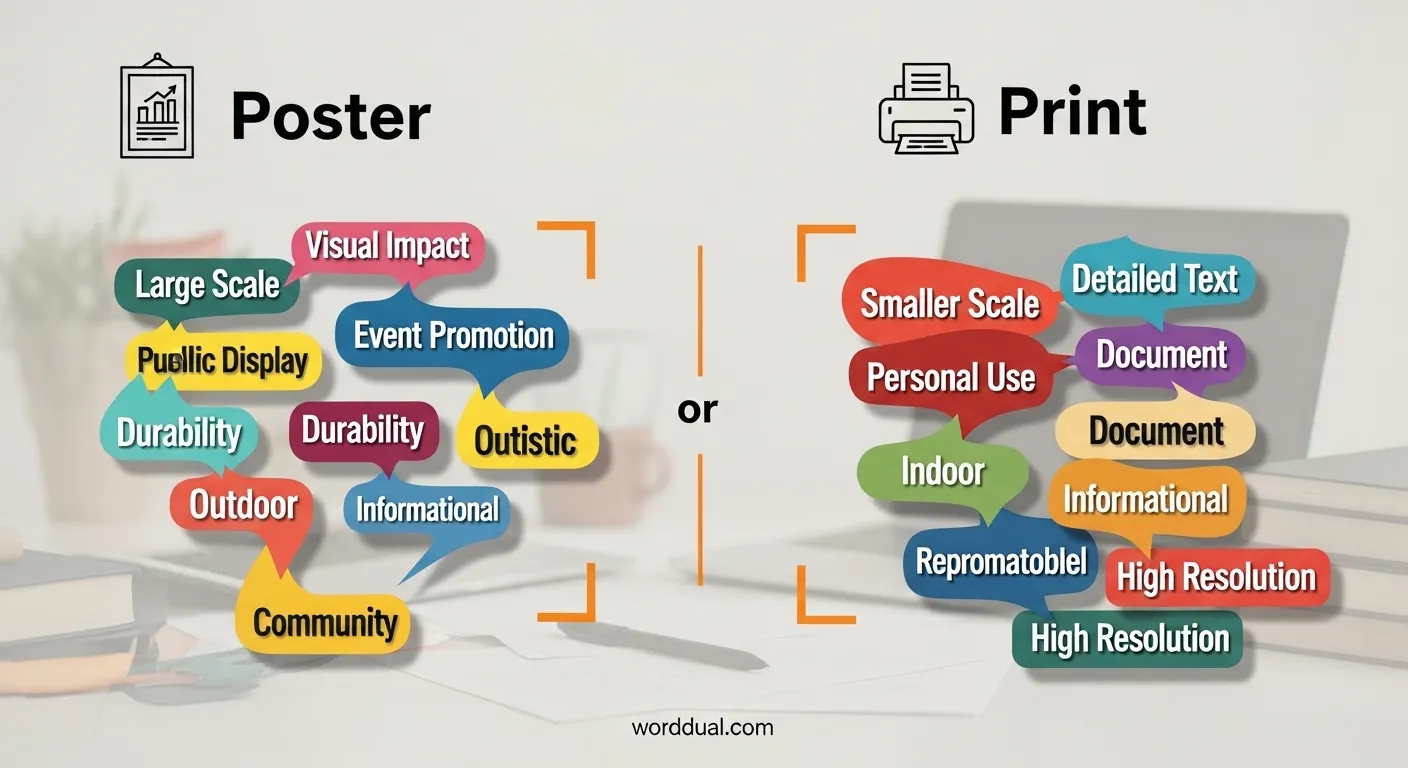
The main difference between poster and print is:
- Poster: Designed for promotion, advertising, or public display.
- Print: A general term for any reproduced image, often used for art or decoration.
Why Is Their Difference Necessary to Know?
Understanding the difference between poster and print is important because:
- Students can choose the right format for projects.
- Designers can create better visual content.
- Businesses can use effective marketing tools.
- Society benefits from clear communication and artistic expression.
This knowledge improves both creativity and communication in everyday life.
Pronunciation
- Poster
- US: /ˈpoʊ.stɚ/
- UK: /ˈpəʊ.stə/
- Print
- US: /prɪnt/
- UK: /prɪnt/
Linking Hook
Now that you know the basics, let’s explore the difference between poster and print in detail with simple examples and clear explanations.
Difference Between Poster and Print
1. Purpose
- Poster: Used for advertising or promotion.
- Example 1: A movie poster outside a cinema.
- Example 2: A school event announcement on a wall.
- Print: Used for art or reproduction.
- Example 1: A printed painting in a frame.
- Example 2: A digital artwork printed for decoration.
2. Design Style
- Poster: Bold and eye-catching.
- Example 1: Bright colors and large fonts.
- Example 2: Clear message with minimal text.
- Print: Detailed and artistic.
- Example 1: Fine art with complex patterns.
- Example 2: High-quality image reproduction.
3. Audience
- Poster: Aimed at the general public.
- Example 1: Advertisements on streets.
- Example 2: Public awareness campaigns.
- Print: Aimed at specific users or buyers.
- Example 1: Art collectors.
- Example 2: Home decorators.
4. Size
- Poster: Usually large.
- Example 1: Wall posters.
- Example 2: Billboard-style prints.
- Print: Can be any size.
- Example 1: Small photo prints.
- Example 2: Medium-sized art prints.
5. Content Focus
- Poster: Focuses on message delivery.
- Example 1: Event date and time.
- Example 2: Promotional slogans.
- Print: Focuses on visual quality.
- Example 1: Artistic details.
- Example 2: Image clarity.
6. Lifespan
- Poster: Short-term use.
- Example 1: Removed after an event.
- Example 2: Seasonal advertisements.
- Print: Long-term use.
- Example 1: Wall decoration for years.
- Example 2: Collectible artwork.
7. Material Quality
- Poster: Standard paper.
- Example 1: Thin glossy sheets.
- Example 2: Low-cost printing paper.
- Print: High-quality material.
- Example 1: Canvas prints.
- Example 2: Premium photo paper.
8. Cost
- Poster: Usually cheaper.
- Example 1: Bulk printing for campaigns.
- Example 2: Low-cost promotional items.
- Print: Often more expensive.
- Example 1: Limited edition art prints.
- Example 2: High-resolution prints.
9. Distribution
- Poster: Mass distributed.
- Example 1: Placed on walls.
- Example 2: Shared in public spaces.
- Print: Selectively distributed.
- Example 1: Sold in galleries.
- Example 2: Ordered online.
10. Function
- Poster: Inform and attract attention.
- Example 1: Political campaign posters.
- Example 2: Safety awareness posters.
- Print: Decorate or preserve art.
- Example 1: Framed photography.
- Example 2: Printed illustrations.
Nature and Behaviour
- Poster:
- Loud, bold, and attention-seeking.
- Designed to communicate quickly.
- Print:
- Calm, detailed, and expressive.
- Designed to be appreciated over time.
Why Are People Confused?
- Both are printed on paper.
- Both display images or text.
- Posters can also look artistic like prints.
- The term “print” is very broad, which causes confusion.
Table: Difference and Similarity
| Feature | Poster | Similarity | |
| Purpose | Promotion | Art/Display | Visual medium |
| Size | Large | Varies | Printed format |
| Design | Bold | Detailed | Use graphics |
| Cost | Low | High | Require printing |
| Lifespan | Short | Long | Used for display |
Which Is Better in What Situation?
A poster is better when you need to share information quickly with a large audience. It works well for events, advertisements, and public awareness campaigns. Posters are affordable and easy to produce in bulk, making them ideal for short-term use.
A print is better when you want quality and long-lasting value. It is perfect for home decoration, art collections, and professional displays. Prints offer better detail and durability, making them suitable for long-term use and personal enjoyment.
Metaphors and Similes
- Poster: “Like a loud voice in a crowded room.”
- Print: “Like a quiet painting telling a story.”
Connotative Meaning
- Poster
- Neutral/Negative: temporary, loud
- Example: His ideas felt like posters—loud but short-lived.
- Print
- Positive: lasting, artistic
- Example: Her work left a print on people’s hearts.
Idioms or Proverbs
- “Leave your mark” (related to print)
- Example: He left his print on the project.
- “Make a big impression” (related to poster)
- Example: The campaign poster made a big impression.
Works in Literature
- Ways of Seeing – John Berger (Art Criticism, 1972)
- The Work of Art in the Age of Mechanical Reproduction – Walter Benjamin (Essay, 1935)
- Prints and Visual Communication – William Ivins (Art Theory, 1953)
Movies Related to Visual Art and Posters
- Exit Through the Gift Shop (2010, UK/USA)
- Big Eyes (2014, USA)
- Helvetica (2007, USA)
FAQs
1. What is the main difference between poster and print?
A poster is for promotion, while a print is for art or decoration.
2. Are all posters prints?
Yes, posters are a type of print, but not all prints are posters.
3. Which is more expensive?
Prints are usually more expensive due to higher quality.
4. Can posters be used as decoration?
Yes, but they are usually less durable than prints.
5. Which lasts longer?
Prints last longer than posters.
How Both Are Useful for Surroundings
- Posters spread awareness and information.
- Prints enhance beauty and creativity.
- Both improve communication visually.
- Both support education and marketing.
Final Words
The difference between poster and print highlights how visual materials serve different purposes. Both are important in communication and art.
Conclusion
Understanding the difference between poster and print helps individuals and professionals make better choices in design and communication.
Posters are powerful tools for quick messaging and public engagement, while prints offer lasting value and artistic depth.
Both play important roles in our daily lives, from advertising to decoration.
By knowing their differences, you can use each effectively based on your needs.
Whether for business, education, or personal use, mastering the difference between poster and print ensures better visual impact and smarter decisions.