Imagine a thief entering a house. In one case, the thief breaks in, destroys everything, and leaves quickly.
In another, the thief quietly hides inside, living unnoticed for a long time before acting.
This simple story helps us understand the difference between lytic and lysogenic cycles.
In biology, viruses behave in similar ways when they infect cells.
The difference between lytic and lysogenic lies in how a virus uses the host cell. Sometimes it destroys the cell immediately, while other times it stays hidden for a long period.
Understanding the difference between lytic and lysogenic is important because it explains how viral infections spread and behave.
Scientists, doctors, and students study the difference between lytic and lysogenic to better understand diseases and develop treatments.
Key Difference Between the Both
The main difference between lytic and lysogenic cycles is:
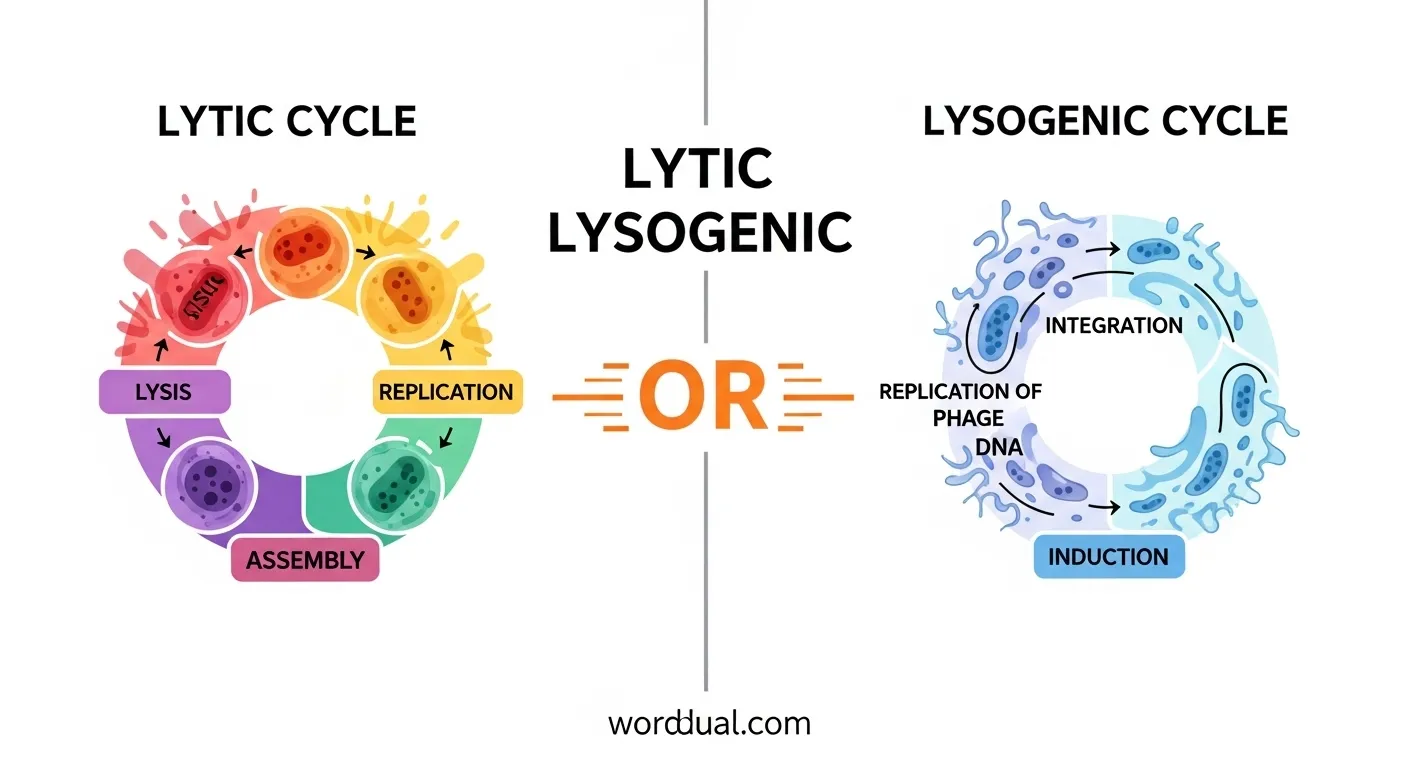
- Lytic cycle: The virus quickly takes control and destroys the host cell.
- Lysogenic cycle: The virus hides inside the host DNA and stays inactive for a while.
Why Is Their Difference Necessary to Know?
Knowing the difference between lytic and lysogenic helps:
- Students understand how viruses function.
- Doctors predict disease behavior.
- Researchers develop antiviral drugs.
- Society manages outbreaks and pandemics.
This knowledge plays a key role in public health and scientific advancement.
Pronunciation
- Lytic
- US: /ˈlaɪ.tɪk/
- UK: /ˈlɪt.ɪk/
- Lysogenic
- US: /ˌlaɪ.səˈdʒɛn.ɪk/
- UK: /ˌlʌɪ.səˈdʒen.ɪk/
Linking Hook
Now that you understand the basics, let’s explore the difference between lytic and lysogenic cycles in detail with clear examples.
H2: Difference Between Lytic and Lysogenic Cycles
1. Mode of Action
- Lytic: Virus immediately attacks the host cell.
- Example 1: Bacteriophage infecting bacteria and bursting it.
- Example 2: Influenza virus rapidly replicating in cells.
- Lysogenic: Virus integrates into host DNA.
- Example 1: Lambda phage inserting DNA into bacteria.
- Example 2: HIV integrating into human DNA.
2. Time Taken
- Lytic: Fast process.
- Example 1: Cell destruction within hours.
- Example 2: Rapid viral spread in infection.
- Lysogenic: Slow process.
- Example 1: Virus remains dormant for years.
- Example 2: Latent infections like herpes.
3. Effect on Host Cell
- Lytic: Kills the host cell.
- Example 1: Cell bursts (lysis).
- Example 2: Tissue damage during infection.
- Lysogenic: Does not kill immediately.
- Example 1: Cell continues normal function.
- Example 2: Virus passed to daughter cells.
4. Viral DNA Behavior
- Lytic: Viral DNA stays separate.
- Example 1: Replicates independently.
- Example 2: Produces new viruses quickly.
- Lysogenic: Viral DNA integrates.
- Example 1: Becomes part of host genome.
- Example 2: Replicates with host DNA.
5. Stability
- Lytic: Unstable and aggressive.
- Example 1: Sudden outbreaks.
- Example 2: Acute infections.
- Lysogenic: Stable and hidden.
- Example 1: Long-term persistence.
- Example 2: Chronic infections.
6. Activation Trigger
- Lytic: Always active after infection.
- Example 1: Immediate replication.
- Example 2: Quick symptoms.
- Lysogenic: Activated by stress.
- Example 1: UV light triggers virus.
- Example 2: Weak immunity activates virus.
7. Genetic Impact
- Lytic: No genetic change in host.
- Example 1: Host destroyed quickly.
- Example 2: No mutation transfer.
- Lysogenic: Alters host genetics.
- Example 1: Adds new traits.
- Example 2: Bacterial toxin production.
8. Spread Pattern
- Lytic: Rapid spread.
- Example 1: Epidemics.
- Example 2: Fast infection cycles.
- Lysogenic: Slow spread.
- Example 1: Hidden infections.
- Example 2: Long incubation period.
9. Virus Production
- Lytic: Produces many viruses quickly.
- Example 1: Burst of viral particles.
- Example 2: Cell rupture releases viruses.
- Lysogenic: No immediate production.
- Example 1: Silent replication.
- Example 2: Delayed virus release.
10. Survival Strategy
- Lytic: Short-term survival.
- Example 1: Rapid multiplication.
- Example 2: Quick host destruction.
- Lysogenic: Long-term survival.
- Example 1: Hidden in host genome.
- Example 2: Avoids the immune system.
Nature and Behaviour
- Lytic Cycle:
- Aggressive, fast, destructive.
- Acts like an invader.
- Lysogenic Cycle:
- Calm, hidden, strategic.
- Acts like a silent guest.
Why Are People Confused?
- Both involve viruses infecting cells.
- Both use host machinery.
- Lysogenic can turn into lytic, causing confusion.
Table: Difference and Similarity
| Feature | Lytic Cycle | Lysogenic Cycle | Similarity |
| Action | Immediate destruction | Delayed action | Both infect host cells |
| Speed | Fast | Slow | Use host machinery |
| DNA | Separate | Integrated | Viral replication |
| Host Effect | Kills cell | Keeps cell alive | Both harmful |
| Spread | Rapid | Gradual | Infect organisms |
Which Is Better in What Situation?
The lytic cycle is useful when rapid viral spread is needed. Scientists study it to understand acute infections and develop quick treatments. It helps in research involving virus behavior and vaccine development.
The lysogenic cycle is better for long-term survival. It helps viruses stay hidden and spread silently. Researchers use it to study genetic changes and evolution. It also helps in biotechnology applications like gene therapy.
Metaphors and Similes
- Lytic: Like a storm that destroys everything.
- Lysogenic: Like a spy hiding in plain sight.
Connotative Meaning
- Lytic
- Negative: destruction, chaos
- Example: His anger was lyric, breaking everything.
- Lysogenic
- Neutral/Positive: patience, hidden strength
- Example: Her plan was lysogenic, waiting for the right moment.
Idioms or Proverbs
(No direct idioms exist, but related ideas:)
- A storm comes suddenly (lytic)
- Example: His reaction was like a storm, sudden and destructive.
- Still waters run deep (lysogenic)
- Example: Her quiet nature hid deep thoughts.
Works in Literature
- The Virus Concept (Science Writing, 1950s)
- Molecular Biology of the Gene – James Watson (1965)
- The Selfish Gene – Richard Dawkins (1976)
Movies Related to Viral Concepts
- Contagion (2011, USA)
- Outbreak (1995, USA)
- World War Z (2013, USA)
FAQs
1. What is the main difference between lytic and lysogenic?
Lytic destroys cells quickly, while lysogenic hides in DNA.
2. Can lysogenic become lytic?
Yes, under stress conditions.
3. Which is more dangerous?
Lytic is immediately harmful, but lysogenic can be dangerous long-term.
4. Why do viruses use lysogenic cycles?
To survive longer and avoid detection.
5. Where are these cycles found?
In bacteriophages and many human viruses.
How Both Are Useful for Surroundings
- Help in genetic engineering.
- Used in medical research.
- Aid in vaccine development.
- Help understand evolution.
Final Words
The difference between lytic and lysogenic cycles shows how viruses adapt and survive. Both strategies are important in science and medicine.
Conclusion
Understanding the difference between lytic and lysogenic cycles is essential for students, researchers, and healthcare professionals.
These two viral strategies explain how infections spread, persist, and impact living organisms.
While the lytic cycle represents fast and destructive action, the lysogenic cycle reflects patience and survival.
Together, they highlight the complexity of viral life.
Learning their differences not only improves scientific knowledge but also helps society prepare for and manage viral diseases effectively.